The Power of Location
March 19, 2025Recruiting Participants for Community Projects: Lessons Learnt
September 19, 2025
A system that delivers the right information, at the right time, in the right place.
Imagine a system that curates and delivers information based on where you are, what you need, and when you need it.
That’s the idea we shared during the TED Countdown Summit in Nairobi last month. And it’s the heart of Homeground — our vision for a world where data doesn’t sit on dashboards, but moves with people. Like a public utility: always on, always near, always useful.
Let me show you where this idea comes from, what we’ve built so far, and why we think it could change the way the world works.
What We’ve Built So Far
At Spatial Collective, we work at the intersection of community and technology. Since 2012, we’ve helped governments, organizations, communities, and everyday people across Africa collect, manage, and use data that matters to them. We’ve:
- Documented every house in Zanzibar using drones, helping residents secure legal land titles.
- Trained hundreds of young people in Nairobi’s informal settlements to use computers, phones, terrestrial cameras, satellite imagery, and geospatial apps to support slum upgrading.
- Used AI to map farms across Kenya and East Africa.
- Deployed terrestrial cameras to document infrastructure in informal settlements.
- Captured the social and economic impacts of large development projects, helping communities advocate for themselves and claim compensation.
- Used participatory mapping and GIS to help communities protect their customary and indigenous land.
- Even explored safety and security across East Africa’s border regions, using data to understand what drives people toward crime and extremism.
A hundred projects later, small and large, we’ve come to see these not just as data, maps, or metrics. They’re stories. Struggles. Solutions. Told through data.
What We’ve Found
After 13+ years of this work, a few truths have become hard to ignore.
#1. Data lives on dashboards. But people don’t.
Too often, data is collected, cleaned, and then parked in reports, PDFs, or dashboards. Sure, data has to live somewhere, but the people the data is about, and who could make the most use of it, often don’t know it exists, can’t access it, or don’t know how to make sense of it.
#2. Life experience differs — sometimes just meters apart.
Anyone who has ever stepped outside of their house knows this: life is lived differently across neighborhoods, cities, and regions. Some communities have reliable access to water, sanitation, waste management, electricity, education, healthcare, and safety. Others don’t. A farmer in Central Kenya needs different information than a youth in Mathare or a herder in northern Kenya. What’s relevant to me in a middle-class part of Nairobi isn’t the same as what’s relevant to someone just a few kilometers away.
#3. We’re no longer suffering from data scarcity — we’re living in data abundance.
Fifteen years ago, huge parts of cities and countries around the world were data “dark spots.” While those still exist, they’re shrinking. We now have more data than ever before.
#4. What we need is better data delivery.
Whether you’re a young person in an informal settlement, a government official managing water services, or someone just going about their day, we need to deliver data based on where people are, what they need, and when they need it.
What’s Possible
That’s where Homeground comes in.
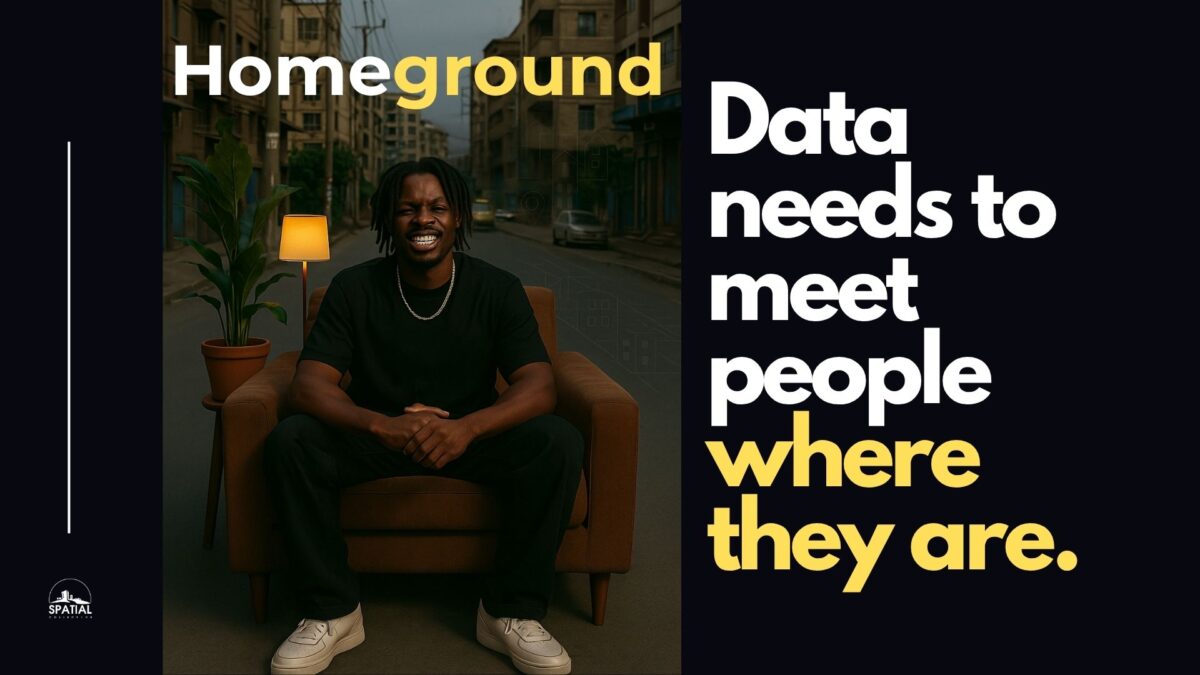
It’s our in-house initiative to prototype a system that curates and delivers useful, contextual information in real time. Based on location, need, and timing.
Picture this:
- A young person in an informal settlement gets real-time job alerts in the vicinity of their neighborhood.
- An informal worker receives information about broken infrastructure that they’re qualified to fix.
- A farmer in rural Kenya gets crop health updates just in time to save their harvest.
- A community comes together to visualize needed infrastructure in real space using AR, before it’s even built.
These aren’t just ideas. We’ve already tested some of them:
- FixMyCommunity (2014): A community marketplace for local problems. People reported issues. Others voted. Local fixers, such as plumbers, electricians, etc., could step up to solve them.
- Mtaa (2020): A hyper-local chat app launched during COVID. It connected people within a 300-meter radius — neighbors who’d never met — at a time when connection mattered most.
- Homeground Housing App (2023): We aggregated Nairobi rental listings from hundreds of scattered sites into one, map-based platform, to help people find a home.
- AI + AR for Urban Planning (Now): We’re experimenting with tools that let you describe needed infrastructure, generate it in 3D with AI, and drop it into your neighborhood using augmented reality.
None of this is sci-fi. We’re building it.
Where We Want To Go From Here
We believe data should behave like a service: accessible, contextual, and actionable. Our long-term goal is to unlock a new way of seeing, to blur the lines between digital and physical worlds, so people don’t just look at data, they move through it.
Whether we build this use case by use case, or through some AI-powered engine that filters and curates data in real time, we’re exploring both.
Here are a few of the questions we’re working through:
- What kinds of data already exist but never reach the people who need them most?
- How can we design data delivery around people’s environments and preferences, not just interfaces and dashboards?
- What would it look like if relevant data appeared around you as you walked through your neighborhood?
- How do we filter for relevance? Manually, per use case? Or can large language models help us scale this?
We don’t have all the answers, but we’re excited to explore them through Homeground: a world where data doesn’t just sit. It moves.